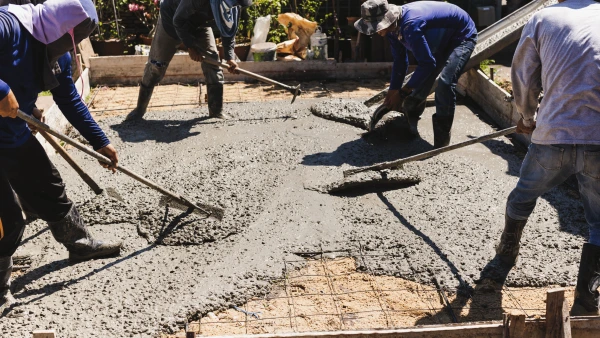
You have two estimates on the counter. One came from a national brand with a call center, a branded truck, and a tablet-based quote emailed before the estimator left the driveway. The other came from a small local outfit where the person who measured your patio is also the person who will run the screed. The prices are close enough that price will not decide it.
That is the moment most homeowners start searching small concrete companies near me, trying to figure out whether local actually buys them anything. It can, and it is worth knowing exactly what. At Hugo’s Concrete, we are the small, owner-led option in Northern Colorado, so treat the comparison below as one we have thought about carefully rather than one we pretend to be neutral on.
Also Read
- Licensed Concrete Contractor Near Me: The Questions to Ask Before You Book
- Fort Collins Patio Builder Case Study: From Drainage Problem to Finished Patio
- Concrete Polishing Contractor: What to Check Before You Hire
TL;DR
Big national concrete brands are built on repeatable process, wide scheduling capacity, and standardized paperwork, which makes them a reasonable pick for a simple, standard pour when you need it on a fixed date. Small local companies concentrate decision-making in one experienced person, keep the same crew on your job start to finish, and know how a specific soil type and a specific city’s rules behave, which matters more as the job gets less standard. The real questions are not local versus national, they are who is physically on site, whether that crew works for the company or is subcontracted, and who answers the phone if something moves in year two.
Key Points
- Almost every concrete company is a small business. Scale in this trade is measured in crews, not in national footprints, and the brand on the truck says little about the crew in your driveway.
- Subcontracting is the real variable. Both models sometimes sell the job and hand it to a sub, and that single fact affects finish quality more than company size does.
- Local knowledge is technical, not sentimental. Expansive clay, freeze and thaw cycles, and city-by-city permit rules change how a slab should be built along the Front Range.
- Nobody inspects residential flatwork. Plain driveways and patios are permit exempt in unincorporated Larimer County, so the crew’s own standard is the only quality control.
- Scheduling is where national brands genuinely win. More crews means more ability to hit a hard date or absorb a weather delay.
- Accountability is where small companies genuinely win. When the owner priced the job, poured the job, and lives 20 minutes away, warranty conversations go differently.
- Compare bids, not business models. An itemized scope with base depth, thickness, mix strength, and joint plan tells you more than any company profile.
What “Small” Actually Means in This Trade
Concrete is a small-business industry almost everywhere, which surprises people who assume the national name implies a fundamentally different operation. In Colorado, the Small Business Administration’s Office of Advocacy counts 20,021 small-business construction employers, or 99.1 percent of all construction employers in the state, employing 77.8 percent of the industry’s workforce. Statewide, small businesses account for 99.5 percent of Colorado businesses and roughly 1.2 million employees.
So when you compare small concrete companies near me against a national brand, you are usually not comparing a corporation to a mom and pop. You are comparing two small operations, one of which has bought into a franchise or marketing network that supplies leads, branding, and a sales process. That can be a real advantage on consistency. It also means the national logo does not guarantee a bigger crew, deeper insurance, or a longer warranty than the local company down the road. Those are things you check individually, not things the brand certifies.
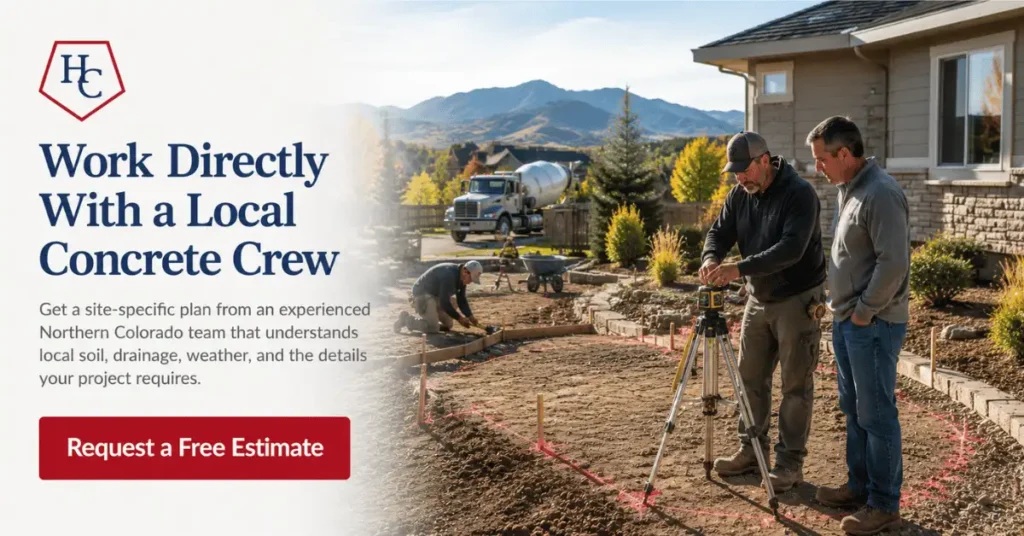
Want a bid that shows its work? We itemize base depth, slab thickness, mix strength, reinforcement, and joint layout so you can compare it against anything else on your counter. Request a free estimate and see the difference on paper.
Where the Two Models Actually Differ
Set the marketing aside and the practical differences come down to about six factors.
| Factor | Small local company | Big national brand |
| Who is on site | Often the owner, plus a crew that stays the same all week | A crew assigned by a scheduler, sometimes a subcontractor |
| Scheduling flexibility | Fewer crews, so a hard date can be harder to hit | More capacity, better at fixed dates and weather recovery |
| Estimating | Measured and priced by someone who will build it | Measured by a salesperson, priced from a standardized system |
| Custom or awkward work | Usually stronger: odd grades, drainage fixes, decorative tie-ins | Usually strongest on standard rectangular pours |
| Warranty in practice | Depends entirely on the owner still being in business and reachable | Backed by a larger entity, but routed through a service process |
| Local conditions | Deep knowledge of a specific county’s soil and permit reality | Process is standardized across very different climates |
Neither column is the right answer for every job. A flat, straightforward 500 square foot garage pad on good soil with a firm deadline is a fine job for a national brand with open capacity. A sloped backyard where the patio has to solve a drainage problem before it can look good is a job where the decision-maker needs to be standing in the yard.
What the National Brands Do Well
It is worth being fair here, because homeowners get pushed toward a false choice.
Large brands run documented processes. The estimate format is consistent, the contract is standardized, the crew has a checklist, and the office does not disappear during a busy stretch. If you have ever had a small contractor go quiet for two weeks mid-project, you know why that matters.
They also carry scheduling depth. When a spring storm pushes every pour in Northern Colorado back four days, a company with six crews recovers faster than a company with one. For a homeowner working around a home sale, a move-in date, or a general contractor’s sequence, that reliability is worth real money.
Where the model strains is anything non-standard. Standardization is efficient precisely because it does not adapt, and Front Range lots are not standard.
Where Small Local Crews Win
The advantages of a local crew are concrete, not sentimental.
One person owns the decisions
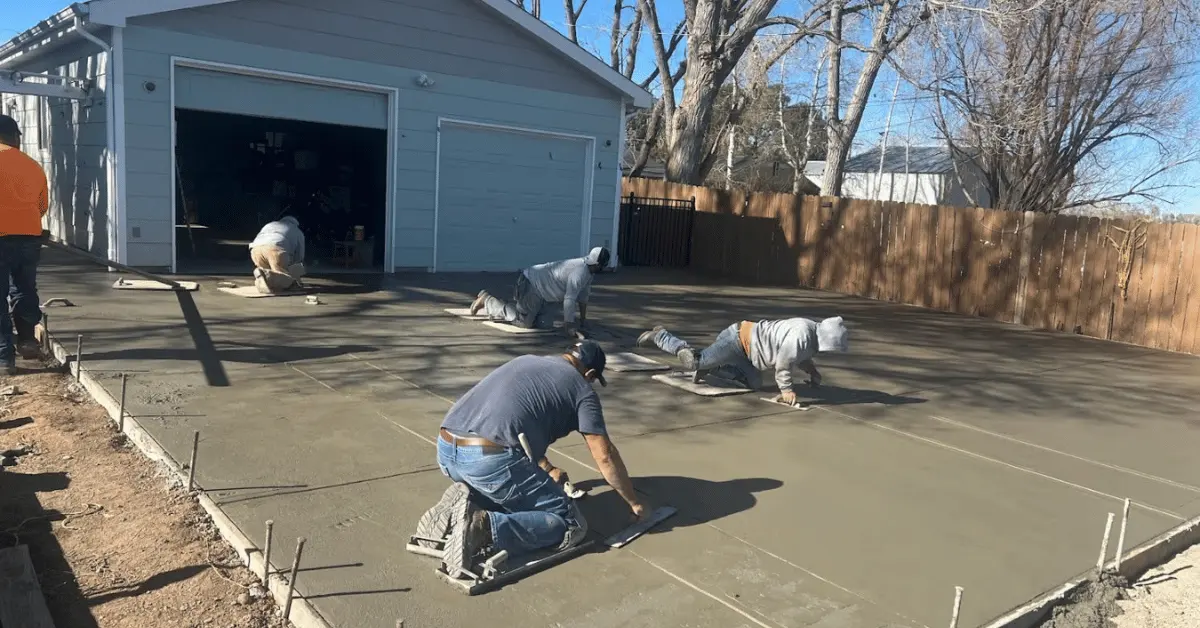
On a small crew, the person who evaluated your soil, set the grade, and specified the mix is present when the truck arrives. Nothing gets lost between a salesperson’s notes and a crew lead’s morning briefing, because they are the same person. That collapses the most common source of finish problems: a plan that was correct on paper and misunderstood on site.
The soil knowledge is specific
Northern Colorado is not a general climate, it is a particular one. The Colorado Geological Survey documents expansive clays along the Front Range that can swell up to 20 percent by volume and exert up to 30,000 pounds per square foot, listing cracked driveways and basement floors among the routine consequences. Freeze and thaw exposure sets the mix requirements: the National Ready Mixed Concrete Association calls for 6 percent total air content and 4,000 psi on exterior slabs exposed to freezing and deicing chemicals. A crew that pours here every week treats those as defaults. A process written for a national footprint treats them as a regional option someone has to remember to select.
Local rules are genuinely local
Permitting in Northern Colorado varies by jurisdiction in ways that catch out-of-town crews. Plain flatwork like driveways and sidewalks is exempt from building permits in unincorporated Larimer County, while setbacks and lot coverage still apply. Inside Fort Collins, altering a sidewalk or drive approach requires an engineering permit and a valid city right of way contractor license, with the drive approach permit starting at $25. Knowing which of those applies to your address before the bid is written prevents an awkward change order later.
Working through a tricky lot? Drainage, slope, and soil are the three things a standardized quote handles worst. We look at all three before quoting. Get your free estimate or call (970) 988-3198.
Which One Fits the Job in Front of You
Rather than picking a side, match the model to the work. This is the shortcut we give homeowners who call us while still deciding.
- Standard rectangular pad, firm deadline, easy access. Either works. Take whoever can hit your date with an itemized scope.
- Sloped yard, drainage problem, or water sitting against the house. Go local, and choose the crew that talks about grade and fall per foot before it talks about finish options.
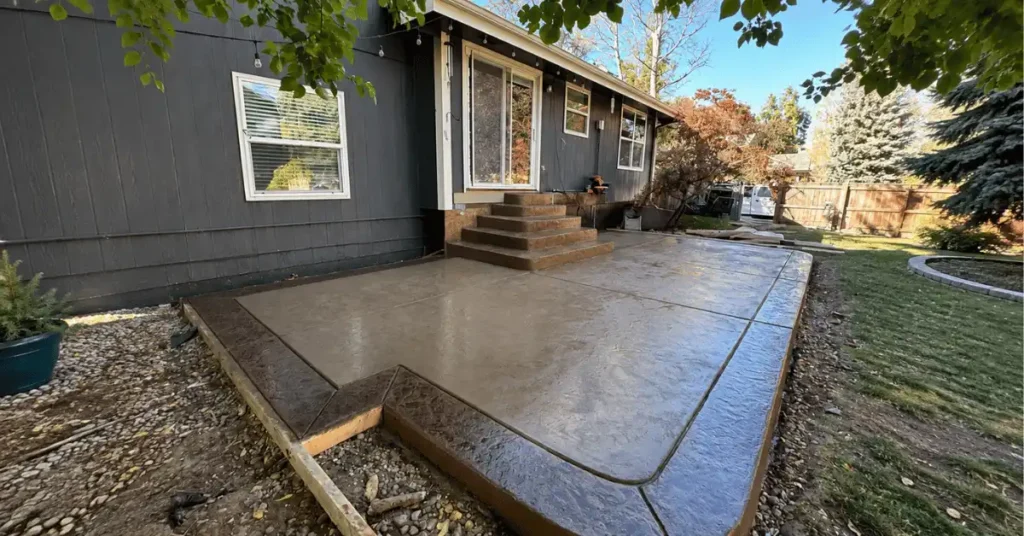
- Decorative work, stamped patterns, or matching existing flatwork. Go local, and go look at finished jobs in person before signing.
- Multi-phase commercial or a job that must coordinate with other trades. Favor whoever has crew depth and a written schedule, regardless of size.
- Repair versus replace uncertainty. Go local. The right answer depends on what is under the slab, and that requires someone willing to say the job is smaller than you thought.
- Any bid without base depth, thickness, and mix strength written down. Neither. Ask for the detail or move on.
Print that list, put it next to your two estimates, and the choice usually makes itself.
Common Questions
Are small concrete companies cheaper than national brands? Not reliably. Small companies carry lower overhead, but national brands buy materials at volume. On the same written scope the two often land within a few hundred dollars, which is why scope detail is a better comparison tool than price.
Do small companies carry enough insurance? Many carry substantial coverage, but you should verify rather than assume. Ask for a certificate of insurance naming general liability limits and workers’ compensation. Larimer County requires both on the license classes it issues, and Fort Collins requires $2 million in general aggregate coverage for most classes.
How do I check a local company’s track record? Look at review depth rather than star average, ask for two addresses poured three or more winters ago, and read what the Federal Trade Commission lists as home improvement warning signs, including cash-only demands, full payment up front, and pressure for an immediate decision.
Does company size affect the warranty? It affects how the warranty is administered more than its length. A larger company routes claims through a process. A small company routes them through the owner. Either can work, provided the terms are in writing before the pour.
Conclusion
The honest answer to small concrete companies near me versus a national brand is that company size is a proxy, and proxies are worth less than the specifics they stand in for. Ask who is on site, whether that crew is employed or subcontracted, what the mix and joint plan are, and how the warranty gets handled when the owner or the office changes. A company of any size that answers those clearly is a reasonable risk. A company of any size that gets vague is not.
Hugo’s Concrete is the small, owner-led option: Hugo runs the company, walks every job, and works with full-time employees rather than rotating subcontractors. More than 20 years of Northern Colorado pours, 900 plus completed projects, and 100 plus five-star reviews sit behind that. We cannot out-schedule a company with six crews, and we do not try. What we can do is make sure the person who priced your job is the person standing on it.
Ready to see how the two bids really compare? We will walk your site, explain what your soil and slope require, and put every line in writing before you decide anything. Request your free estimate or call (970) 988-3198.