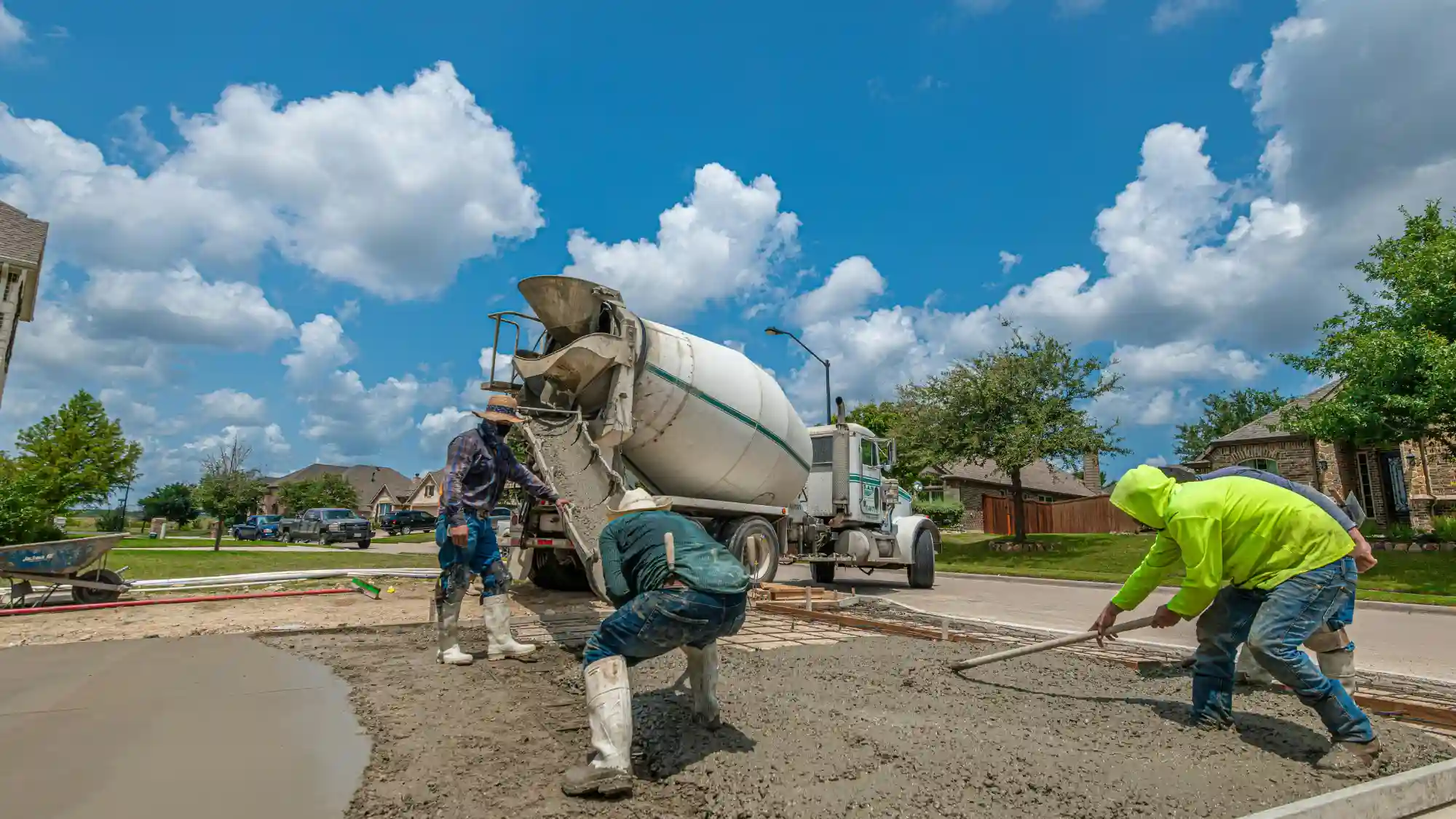
Typing concrete guys near me into your phone gets you a map, a dozen company names, and almost no way to tell them apart. Every listing says licensed. Every listing offers a free estimate. Then three bids come back on the same 600 square foot driveway and they are $4,000 apart, with nothing in writing that explains the gap.
The difference is rarely the concrete itself. Ready mix out of the same Loveland plant can go into a slab that holds up for 30 years or one that flakes apart after three winters. What separates them is what happens before and after the truck shows up: soil evaluation, base compaction, reinforcement, joint work, and whether anyone with real experience is standing on the job while it happens. At Hugo’s Concrete, owner Hugo is on site for Fort Collins concrete work personally, and what follows is the checklist we would hand a neighbor before they signed anything.
Also Read
- Concrete Contractor Pricing: What Goes Into a Real Bid?
- Common Concrete Installation Mistakes NOCO Homeowners Should Avoid
- Licensed Concrete Contractor Near Me: The Questions to Ask Before You Book
The Short Version
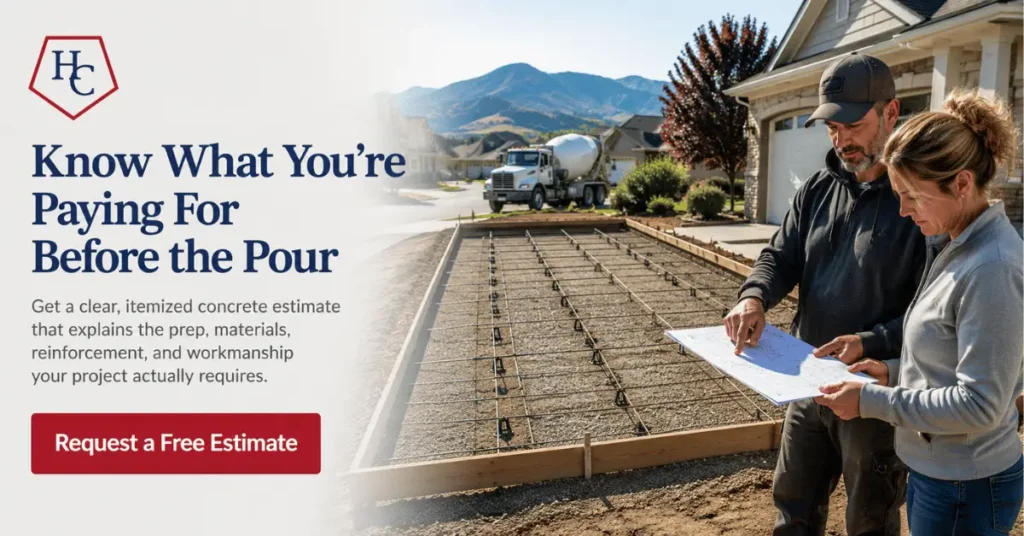
A professional concrete crew spends most of its budget on things you will never see: excavating to the right depth, compacting a proper road base, setting grade so water leaves the slab, placing reinforcement, using an air entrained mix rated for freeze and thaw, cutting control joints at the correct spacing and depth within hours of finishing, and curing the surface instead of walking away. A cut-rate crew skips several of those steps and pours a thinner slab on native soil, which is exactly why the low bid can be thousands cheaper and still cost more in the end. You cannot judge a crew by its listing, but you can judge it by its bid, its joint plan, its mix specification, and the work it has finished nearby.
Not sure which bid is the honest one? Send us the scope and we will walk you through what should be itemized, line by line. Request a free estimate and get a straight answer on what the job actually takes.
What a Search for Concrete Guys Near Me Does Not Tell You
Local search ranks businesses on proximity, category, review volume, and profile completeness. None of those measure whether a crew compacts base in lifts or cuts joints on time. A company that pours thin slabs on uncompacted dirt can hold a strong star rating for years, because the failure mode is slow. Cracking, heaving, and surface scaling usually show up in winter two or three, long after the review was written.
Licensing does not sort the list for you either. Colorado has no statewide license for concrete contractors, so “licensed” means something different depending on the jurisdiction. In Fort Collins, general contractor classes require passing an ICC National Standard Building Contractor exam and carrying $2 million in general liability coverage, and any work touching the public right of way requires a separate city right of way contractor license. Larimer County requires workers’ compensation coverage and general liability on every contractor license class it issues. Meanwhile, plain residential flatwork sits outside the permit system entirely: the county lists concrete flatwork such as driveways or sidewalks as exempt from building permits. No inspector is coming to check the base or the rebar. The only quality control on a residential pour is the crew’s own standard.
That is the real reason bids diverge so far. On most flatwork jobs, nobody is checking the work but you.
Watch the Prep, Not the Pour
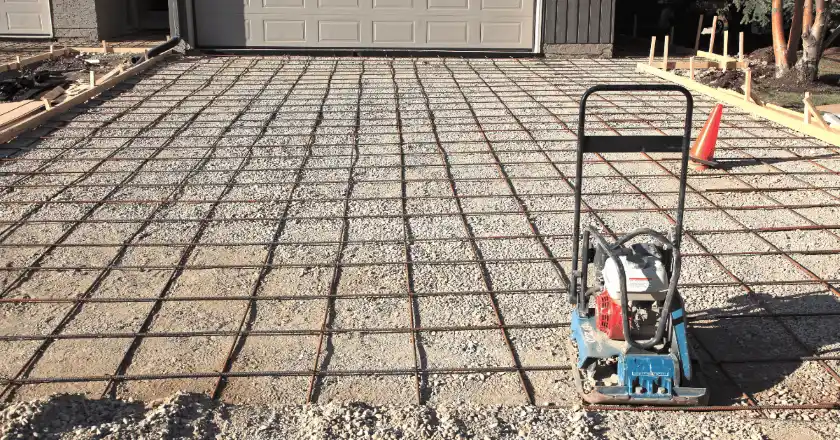
Pouring is the fast, photogenic part. Prep is where the money and the durability live, and it is the first thing a cut-rate crew trims.
Soil comes first in Northern Colorado
The Front Range sits on some of the most reactive clay in the country. The Colorado Geological Survey notes that expansive clays can swell up to 20 percent by volume and exert forces up to 30,000 pounds per square foot when they take on water, and it lists cracked driveways, sidewalks, and basement floors among the most common results. A slab poured directly onto that clay is riding a surface that moves. A slab poured onto excavated, moisture-conditioned, compacted road base is riding something stable.
Ask about depth, lifts, and compaction
A professional bid names an excavation depth and a base thickness, typically 4 to 6 inches of Class 6 road base compacted in lifts rather than dumped and driven over once. It also names how grade will be set so water sheds off the slab instead of pooling against the house. If the estimator never mentions grade or drainage, they have not looked at your lot, they have measured a rectangle.
Reinforcement is a specification, not a promise
“We use rebar” is not a specification. Bar size, spacing, and whether it is supported off the base all matter. Rebar lying flat on the ground and pulled up by hand during the pour does very little. Fiber in the mix helps with plastic shrinkage cracking but is not a substitute for structural steel where vehicles will park.
Reading a Finished Slab: What the Surface Tells You
The fastest way to evaluate a crew is to stand on something they poured three or four winters ago. Ask for two addresses within 15 minutes of your house, then go look. Here is how to read what you find.
| What you see | What it usually means | What to ask the crew |
| Random cracks wandering across panels | Control joints cut too late, too shallow, or spaced too far apart | How far apart will you cut joints, how deep, and how soon after finishing? |
| Flaking or peeling surface after one or two winters | Non air entrained mix, water worked into the surface during finishing, or deicer used the first season | What air content and design strength are in the mix? |
| Water standing on the slab a day after a storm | Grade was never set for drainage | Where does water leave this slab, and what fall per foot are you setting? |
| Chalky dust that comes off on your shoe | Curing was skipped or cut short | How will the slab be cured, and for how long? |
| Crumbling edges along the driveway apron | Thin edges over a weak or missing base | How thick is the slab at the edge, and what is underneath it? |
Those failures are documented, not mysterious. The National Ready Mixed Concrete Association ties surface scaling to non air entrained concrete, low strength, poor finishing, and inadequate curing, and recommends 6 percent total air content and 4,000 psi for exterior slabs exposed to freezing and deicing chemicals. Joint spacing has published guidance too: contraction joints should sit at 24 to 36 times the slab thickness, capped at 15 feet, cut at least a quarter of the slab depth, and sawed within 4 to 12 hours of finishing. For a 4 inch slab that is roughly 10 foot panels, at least an inch deep, cut the same day or the next morning.
When a crew can answer those numbers without looking anything up, you are talking to a professional. When the answer is “we do it the standard way,” you are talking to a salesperson.
Want a second opinion on a slab you already have? We look at existing flatwork every week and tell homeowners honestly whether it needs repair or replacement. Get your free estimate or call (970) 988-3198.

The Bid Is the Biggest Tell
A real bid reads like a plan. It names the square footage, the slab thickness, the base material and depth, the mix strength, the reinforcement, the joint layout, the finish, and what happens to the old concrete. A cut-rate bid is a number on a business card with “concrete work” written above it. That vagueness is not sloppiness, it is flexibility: nothing was promised, so nothing was skipped.
Payment terms tell you as much as the scope. The Federal Trade Commission’s guidance on avoiding home improvement scams flags contractors who solicit door to door because they are “in the area,” pressure you for an immediate decision, ask for the full amount up front or cash only, or ask you to pull the permits yourself. Every one of those shows up in residential concrete. A reasonable deposit covers materials. A demand for the whole job before a shovel moves covers the contractor’s last mistake.
One more filter that costs you nothing: ask who is actually pouring. Some companies sell the job and hand it to whichever sub is available that week, which is why the finish quality on two jobs from the same brand can look nothing alike. Our crew at Hugo’s Concrete are full time employees, and you can see the results across our recent work rather than taking that on faith.
Three Myths That Cost Northern Colorado Homeowners Money
Most bad concrete decisions trace back to one of these three beliefs. Each one sounds reasonable and each one is wrong.
- Myth: concrete is concrete, so buy the cheapest pour. Mix design, air content, and strength are chosen per job. A 3,000 psi non air entrained mix and a 4,500 psi air entrained mix look identical coming out of the chute and behave nothing alike in February.
- Myth: rebar means it will not crack. All concrete cracks. Reinforcement and joints decide whether it cracks where you planned or wanders across the middle of your driveway.
- Myth: a low bid on the same scope is just a better deal. On flatwork with no permit and no inspection, a lower price almost always means less base, a thinner slab, or a cheaper mix, because those are the only places large enough to cut.
Read those three the next time you compare estimates and most of the confusion clears up on its own.
Questions Homeowners Ask Before Hiring
How thick should my driveway slab be? Four inches is standard for patios, sidewalks, and garage slabs on a properly prepared base. Driveways generally run 4 to 5 inches, and 5 to 6 inches where work trucks, trailers, or an RV will park.
How many bids should I get? Three is a good number, but only if all three are quoting the same scope. If one bid does not list base depth, thickness, and mix strength, you are comparing two plans and one guess.
Do I need a permit for a new driveway or patio in Larimer County? Plain flatwork is exempt from building permits in unincorporated Larimer County, though setbacks, lot coverage, and floodplain rules still apply. Work that touches a city sidewalk or drive approach in Fort Collins does require an engineering permit and a licensed right of way contractor.
How long before I can drive on new concrete? Foot traffic after 24 to 48 hours, vehicles after roughly 7 to 10 days, and full design strength at about 28 days. Keep deicing salt off it the entire first winter.
Conclusion
Searching concrete guys near me will always return more names than useful information. The list cannot tell you who compacts base in lifts, who cuts joints the same evening, or who will still answer the phone in year three. What it can do is give you a starting set of names to run through the same four filters: an itemized bid, a stated mix and joint plan, local work you can go stand on, and payment terms that do not put your money at risk before the work starts.
Hugo’s Concrete has spent more than 20 years and 900 plus projects pouring for Northern Colorado soil and Northern Colorado winters. Hugo runs the company and walks the jobs himself, the crew are full time employees rather than rotating subs, and every job is licensed, insured, and warranty backed. That is the whole pitch: same crew, same standard, work you can go look at.
Ready to compare a real bid against the one you have? We will walk your site, explain the prep, and put every line item in writing before you commit to anything. Request your free estimate or call (970) 988-3198 to talk it through.