Concrete patio reinforcement doesn’t stop your patio from cracking. That’s the first thing worth clearing up, because most homeowners hear “reinforced” and picture a slab that won’t crack. Concrete shrinks as it cures, and it will crack somewhere. The National Ready Mixed Concrete Association puts it plainly in its guidance on cracking concrete surfaces: “Wire mesh and reinforcement in slabs cannot prevent cracking.” What reinforcement does is decide whether those cracks stay hairline and locked together, or open up into the trip hazard you’re looking at right now on a neighbor’s ten-year-old slab.
That distinction matters more here than it does almost anywhere else in the country. Northern Colorado sits on expansive clay that moves under a slab every time the moisture content changes, and a patio has to ride out that movement for decades. At Hugo’s Concrete, we build concrete patios across Fort Collins, Loveland, Windsor, and Greeley, and the reinforcement conversation is one we have on almost every estimate. Here’s how the three pieces work together.
Also Read
- The Importance of Using Rebar When Pouring Concrete
- Ground Compaction: Key to Durable Concrete in Northern Colorado
- Concrete PSI Levels: Everything You Need to Know About Strength and Durability
The Short Version
Concrete patio reinforcement is really three separate things working together, and homeowners tend to treat them as one. The base carries the load and keeps support uniform, so it’s the piece that decides whether the slab moves at all. Rebar or wire mesh holds the two sides of a crack together once one forms, which keeps the surface flat and the joint tight. Fiber goes in the mix itself and cuts down the fine surface cracking that happens in the first day, before the slab has any real strength. Fiber can’t replace steel, steel can’t replace a compacted base, and a great base won’t save a slab poured too thin. When a bid says “reinforced,” ask which of the three it means, because on a lot of low bids the answer is only the cheapest one.
Key Points
- Reinforcement controls crack width, not crack occurrence. Every slab cracks. Good reinforcement keeps those cracks tight and level instead of letting them spread and lift.
- Position matters more than quantity. Steel dragged along the bottom of the slab does close to nothing. It has to sit in the upper portion of the pour and stay there through the finish.
- Fiber and steel solve different problems. Fiber handles early-age shrinkage cracking in the first hours. Steel handles what happens over the next twenty years.
- The base is the part nobody sees and everybody skips. Uniform, compacted support does more for longevity than any amount of steel laid over soft ground. Colorado clay that swells when it gets wet makes that support harder to achieve here than in a dry, stable region.
- Joints are part of the reinforcement plan. Control joints tell the slab where to crack, so skipping them or spacing them wrong undoes the rest of the work.
- Thickness sets the ceiling. Four inches is standard for a patio, and a hot tub, an outdoor kitchen, or a heavy pergola pushes that number up before reinforcement even enters the conversation.
Not sure what’s in your bid? Send us the scope and we’ll tell you what the concrete patio reinforcement line item really covers, at no cost. Request a free estimate or call (970) 988-3198.
What Concrete Patio Reinforcement Does in a Slab
Concrete is strong in compression and weak in tension. Push down on it and it holds. Bend it over a soft spot and it fails. Every patio slab sees tension, because the ground underneath it isn’t perfectly uniform and never stays still.
When a slab does crack, the question becomes what happens next. Without reinforcement, the two sides drift apart, water gets into the gap, and freeze-thaw cycles pry it wider every winter. With steel crossing that crack, the two halves stay tied together and stay at the same elevation. NRMCA’s guidance is specific on this: reinforcement placed in the right spot “can reduce crack width.”
That’s the whole job. It isn’t glamorous, and it’s the difference between a hairline you have to look for and a half-inch gap with a lip you catch your toe on. A tight crack is cosmetic. A wide one collects water, and water in Northern Colorado freezes about half the year, which pries the edges apart and starts spalling the surface. Keeping cracks tight is how you keep a patio out of the repair cycle.
Rebar: Sizes, Spacing, and Where It Belongs
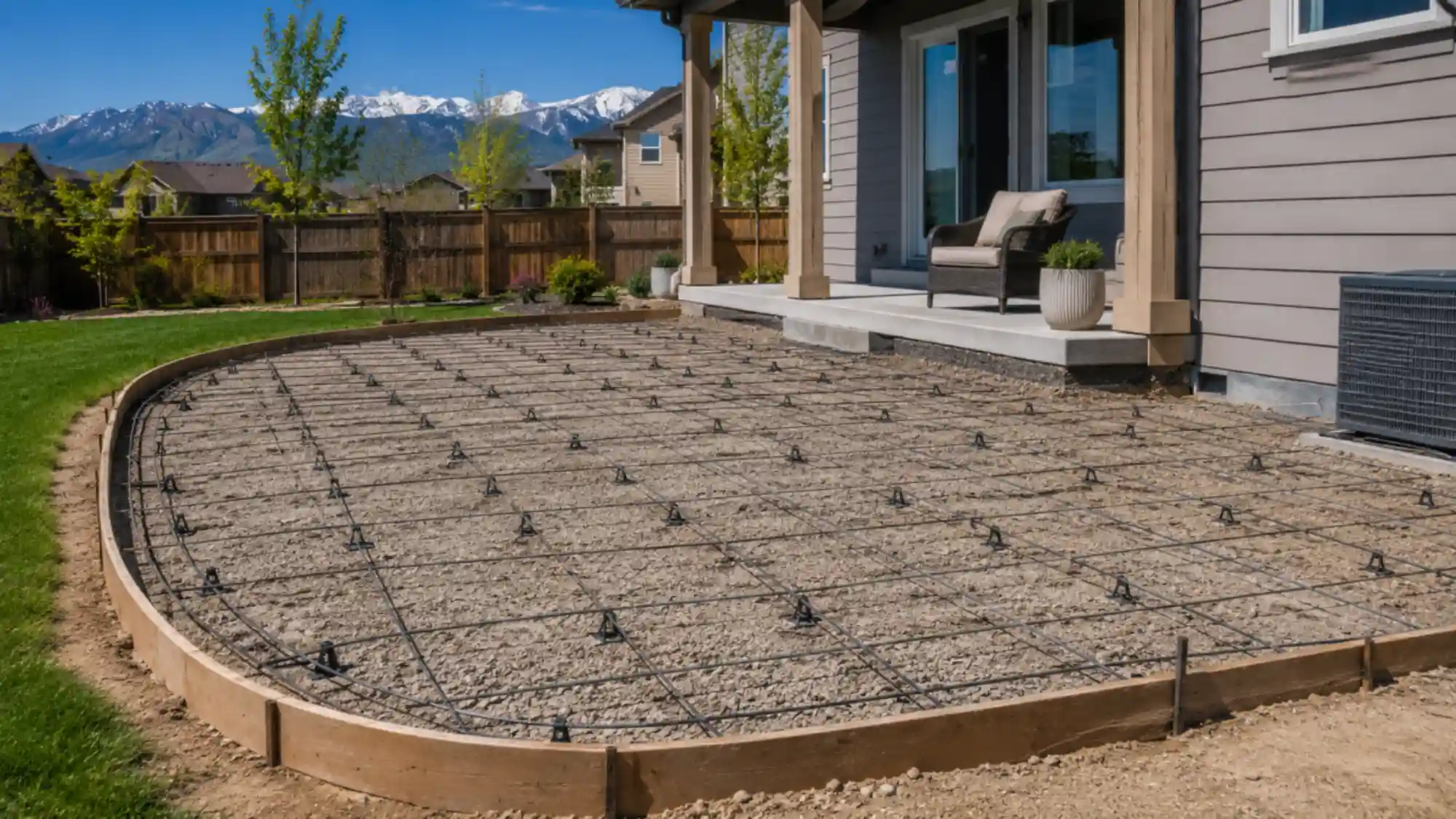
Rebar is deformed steel bar, tied into a grid and supported off the base so it ends up inside the concrete rather than under it. For residential flatwork, #3 bar (three-eighths of an inch) and #4 bar (half an inch) cover almost every situation, and we use #3 or larger on patios where reinforcement is called for. Spacing depends on the slab. An 18-inch grid is common on a standard patio, tightening toward 12 inches under heavy point loads like a hot tub or a stone fireplace. The number that gets argued about less and matters more is the vertical position.
The mistake that ruins good steel
Steel does its work when it sits high in the slab, not on the ground. The American Concrete Institute is direct about the shortcut. ACI 302.1R states that reinforcement “should not be placed on the ground and pulled up after placement of the concrete, nor should the mats be walked in after placing the concrete.”
The American Society of Concrete Contractors takes the same position in its statement on welded-wire reinforcement. It adds a practical detail: supports have to be spaced close enough that the reinforcement “cannot be forced out of location by foot traffic.” If you drive past a pour and the steel is lying flat on the dirt with a crew walking over it, the reinforcement line item on that bid isn’t buying what the homeowner thinks it’s buying.
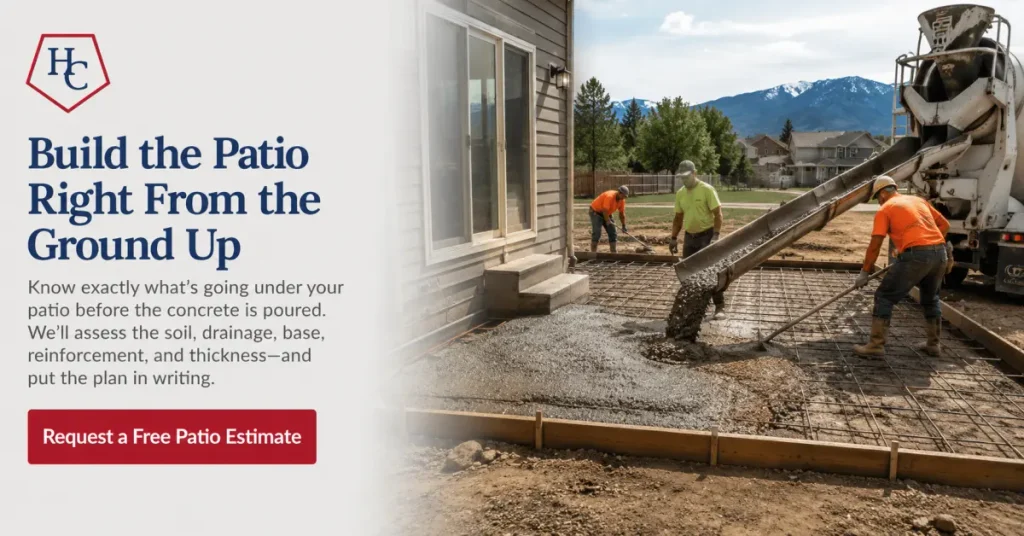
You can see this on our recent work: the steel is up on chairs before a single yard of concrete shows up.
Want to see the spec before you commit? We walk every patio estimate through base depth, reinforcement, thickness, and joint layout in writing. Get your free estimate.
Fiber: What It Fixes and What It Doesn’t
Fiber is mixed in at the plant, so it’s distributed through the whole slab rather than sitting on a plane. Micro synthetic fibers go in at roughly one to two pounds per cubic yard and work against the fine cracking that shows up in the first hours, before the concrete has meaningful strength. Macro synthetic fibers are thicker, dose in around five pounds per cubic yard, and add toughness to the hardened slab.
NRMCA’s sheet on synthetic fibers is clear about the boundary, and it’s a boundary some contractors blur when they’re selling. Fibers should not be used for “replacement of any moment-resisting or structural steel reinforcement,” and they don’t control cracking caused by external forces. Fiber is insurance on day one. Steel is insurance on year fifteen.
We run fiber reinforcement in every mix we pour, and we add #3 rebar or mesh on top of that where the slab calls for it. Those aren’t competing choices, and a bid that offers fiber instead of steel on a patio carrying real load is offering you the cheaper half of the answer.
Rebar, fiber, and mesh side by side
| Reinforcement | What it does well | What it can’t do | When we use it on a patio |
|---|---|---|---|
| Rebar (#3 or #4) | Holds cracks tight and level over the life of the slab, handles point loads | Prevent cracking, help in the first 24 hours | Hot tub pads, outdoor kitchens, slabs over disturbed or reworked soil, anything on a grade change |
| Synthetic fiber | Cuts early-age shrinkage cracking, adds toughness through the full thickness | Replace structural steel, control cracks from soil movement | Every pour, as a baseline, never as the only reinforcement on a loaded slab |
| Welded wire mesh | Ties cracks together at lower cost than a full rebar grid | Do anything at all if it ends up on the subgrade | Standard-load patios where it can be properly supported and kept in position |
Wire Mesh and Why It So Often Disappoints
Mesh gets a bad reputation it only half deserves. Properly supported mesh in the upper third of a slab works. The trouble is that mesh is flexible, easy to step through, and cheap to install badly, so it fails in the field far more often than it fails in theory. The ASCC position statement notes that specifications typically call for wire reinforcement to sit about two inches below the slab surface, or within the upper third of the thickness. It then acknowledges how hard that position is to hold during a pour, and recommends rebar when the cost of supporting mesh correctly climbs.
That’s the honest version. If a crew supports mesh on chairs and protects it during the pour, mesh is fine. If they roll it out on the dirt and hook it up with a rake, you’d rather have rebar, and you’d rather know that before the truck arrives.
The Base Under the Steel Decides How Long Any of It Lasts
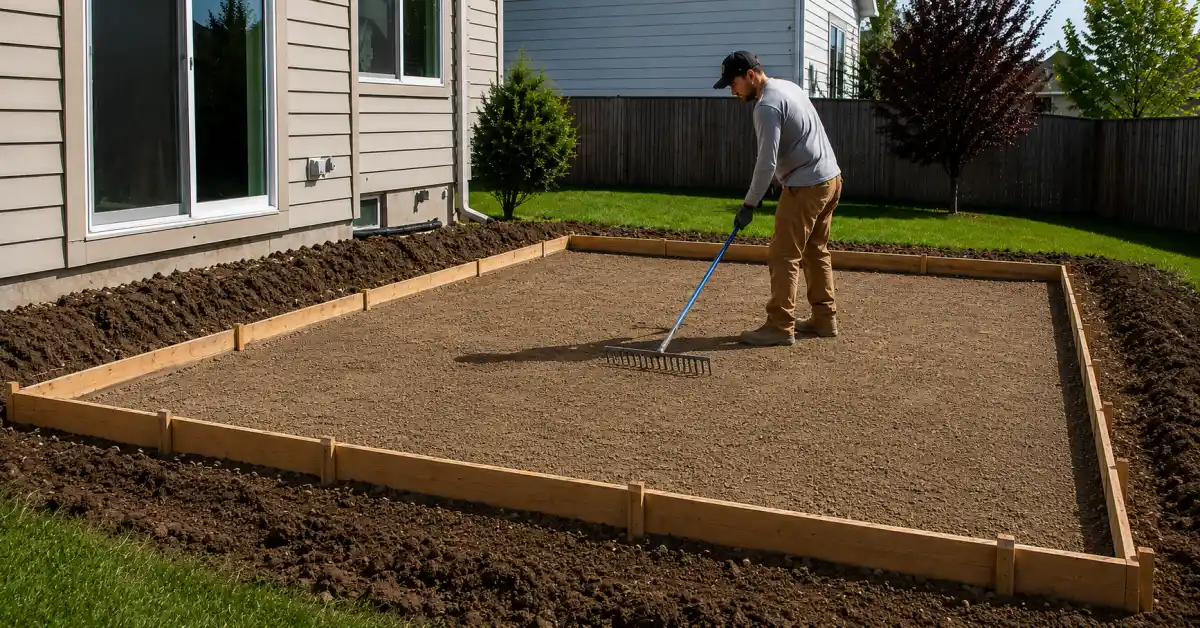
Reinforcement manages cracks. The base decides how much cracking there is to manage.
The American Concrete Pavement Association’s guidance on subgrades and subbases makes the ranking explicit: “Above all other design concerns, uniformity is of utmost importance.” Their field data backs it up, showing that low-strength soils with uniform support outperformed stronger soils that lacked it.
That’s why concrete patio base preparation belongs in the same conversation as concrete patio reinforcement, and why neither one is a line item to shop on price. NRMCA’s cracking guidance spells out the sequence: “All topsoil and soft spots should be removed. The soil beneath the slab should be compacted soil or granular fill, well compacted by rolling, vibrating or tamping.” On the pavement side, 95 percent compaction under AASHTO T99 is the benchmark for an adequate working platform. We run 4 to 6 inches of compacted base under residential flatwork, compacted in passes rather than one thick lift.
What Colorado clay adds to the problem
Northern Colorado makes uniform support harder to achieve and more important to get right. The Colorado Geological Survey reports that expansive clays can swell up to 20 percent by volume when they take on water, exerting forces of up to 30,000 pounds per square foot on slabs and foundations. The timing is the part homeowners miss: subsurface clay usually sits relatively dry, so swelling starts after development, when irrigation, roof runoff, or a regraded yard introduces water that wasn’t there before.
A slab sitting on clay that swells in one corner and stays dry in another isn’t facing a materials problem. It’s facing differential movement, and the only real defenses are base preparation, drainage that moves water away, and reinforcement sized for the conditions.
Mix, air, and joints round it out
Two more specs belong in the same conversation. NRMCA’s guidance on scaling recommends 6 percent total air content for concrete with three-quarter-inch or one-inch aggregate, and a specified strength of 4,000 psi for exterior slabs facing freezing temperatures and deicing chemicals. We pour minimum 4,000 psi air-entrained concrete on exterior flatwork for exactly that reason.
Joints finish the job. NRMCA’s sheet on joints in concrete slabs sets three numbers worth knowing. Contraction joints go in at 24 to 36 times the slab thickness, capped at 15 feet. The groove runs at least a quarter of the slab depth and never less than an inch. Conventional saw cuts happen within 4 to 12 hours of finishing. On a 4-inch patio, that’s joints at 8 to 12 feet. Get the spacing wrong and the slab picks its own crack line, which is the one place reinforcement can’t help you.
Pouring on clay? Base depth, drainage, and reinforcement have to be decided together, not priced separately. Schedule your on-site estimate and we’ll look at the soil you have.
Three Myths About Concrete Patio Reinforcement
Myth one: rebar prevents cracks. Any contractor promising a crack-free slab is promising something concrete can’t deliver. Rebar keeps cracks tight and keeps both sides at the same height, which is a durability promise rather than a cosmetic guarantee.
Myth two: fiber means you can skip the steel. NRMCA’s own guidance rules out synthetic fibers as a substitute for structural steel. On a patio carrying a hot tub or spanning reworked soil, fiber alone leaves you short.
Myth three: more reinforcement makes up for a bad base. The pavement research is blunt about it. No amount of steel compensates for support that varies across the slab, and a thin, well-prepared, well-drained base beats a deep pile of uncompacted fill every time.
Straight Answers on Patio Reinforcement
Do you need rebar in a concrete patio? Not always. A standard four-inch patio on well-compacted, uniform base with correct joint spacing can perform well with fiber and properly supported mesh. Add a hot tub, an outdoor kitchen, a vehicle, or soil that’s been disturbed, and rebar becomes the right call.
Fiber mesh vs rebar: which one should I choose? Neither one on its own. Fiber belongs in the mix on every pour, and rebar or supported wire mesh belongs in the slab whenever the load or the soil justifies it. Framing it as a choice usually means someone is trying to price down the bid.
How thick should a concrete patio be? Four inches is standard for patios, sidewalks, and garage slabs on a properly prepared base. Heavier loads push that to six inches, and thickness also drives joint spacing, since joints are set as a multiple of slab thickness.
Conclusion
A patio that’s still flat, tight, and level in fifteen years isn’t the product of one decision. It’s a compacted base, steel positioned high enough in the pour to do its job, fiber in the mix to handle the first day, air-entrained concrete at the right strength, and joints cut on time and on spacing. Concrete patio reinforcement only works when the base, the mix, and the joints hold up their end.
Hugo has run crews across Northern Colorado for more than 20 years, and Hugo’s Concrete has completed 900 or more local projects with over 100 five-star Google reviews behind them. We’re licensed under Colorado License # 20211954844, carry $2 million in liability insurance, and hold AAA accreditation through the BBB. Our crews are full-time employees rather than subcontractors, which is a large part of why the base and the steel look the same on job number 900 as they did on job number nine. There’s more on how we work on our about us page.
Ready for a straight answer on your patio? We’ll walk the site, look at the soil and the drainage, and put the base depth, reinforcement, thickness, and joint plan in writing before anything gets poured. Request a free estimate or call (970) 988-3198.