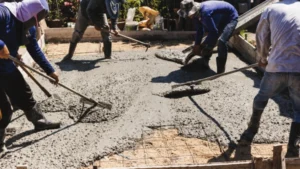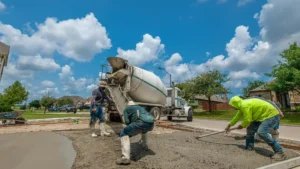
Northern Colorado concrete has to survive conditions that concrete in milder climates never faces. Our slabs sit on clay that swells and shrinks with the seasons, freeze night after night, thaw by afternoon, and take direct high-altitude sun the rest of the year. A driveway that would last 40 years in a stable climate can crack and heave here in a handful of winters if it was not built for the ground and weather it lives on.
That is why hiring for concrete in this region is its own skill. The mix, the thickness, the base prep, and the finishing all have to account for local conditions, and a contractor who treats a Fort Collins driveway like a slab anywhere else is setting you up for early failure. At Hugo’s Concrete, we’ve poured and finished more than 900 projects across Northern Colorado, and this guide walks through what good work requires here and the exact questions to ask before you hire, whether your project is a driveway, a patio, or a floor.
Also Read
- Is Loveland’s Climate Suitable for Concrete Projects Compared to Windsor & Greeley?
- How Thick Should a Concrete Driveway Be in Fort Collins
- Protect Your Concrete: Why Avoiding Salt is Crucial for Longevity
TL;DR
Northern Colorado concrete faces two big enemies: freeze-thaw cycling and expansive clay soil. Good work in this region uses air-entrained concrete rated for freeze-thaw, adequate strength for exterior use, correct thickness on a properly compacted base, control joints at the right spacing, and real curing. Before you hire, ask how the contractor preps the base, what mix and air content they use, how they place joints, and how they cure the slab. The answers reveal whether you are getting a crew that understands local concrete or one that pours the same slab everywhere.
Why Northern Colorado Concrete Is a Different Job
Two regional forces work against every slab poured along the Front Range, and understanding them makes you a much sharper buyer.
The first is our soil. Much of Northern Colorado sits on expansive clay. The Colorado Geological Survey describes swelling soils as one of the most costly and damaging geologic hazards in the state, because the clay minerals in our ground absorb water and expand, then shrink as they dry. The U.S. Geological Survey explains that swelling clays like montmorillonite can change volume dramatically as their moisture changes. That movement is what lifts, tilts, and cracks a slab that was not built to ride it out.
The second force is freeze-thaw. Water that soaks into concrete expands when it freezes, and along the Front Range that cycle can repeat many times in a single winter. The defense is air-entrained concrete, which builds microscopic air bubbles into the mix to give freezing water somewhere to go.
The American Concrete Institute and the cement industry both identify air entrainment as essential to freeze-thaw durability, and the American Cement Association notes that entrained air can dramatically increase the number of freeze-thaw cycles concrete withstands. Skip it, and the surface scales and flakes within a few seasons.
Put those two together and the lesson is clear: Northern Colorado concrete is a prep-and-mix job as much as a pouring job. The contractors who understand that build slabs that last. The ones who do not leave you a repair bill.
Planning a project and want it done for our conditions, not despite them? Start with a local crew that builds for freeze-thaw and clay. Request a free estimate from Hugo’s Concrete.
What Good Concrete Practice Looks Like Here
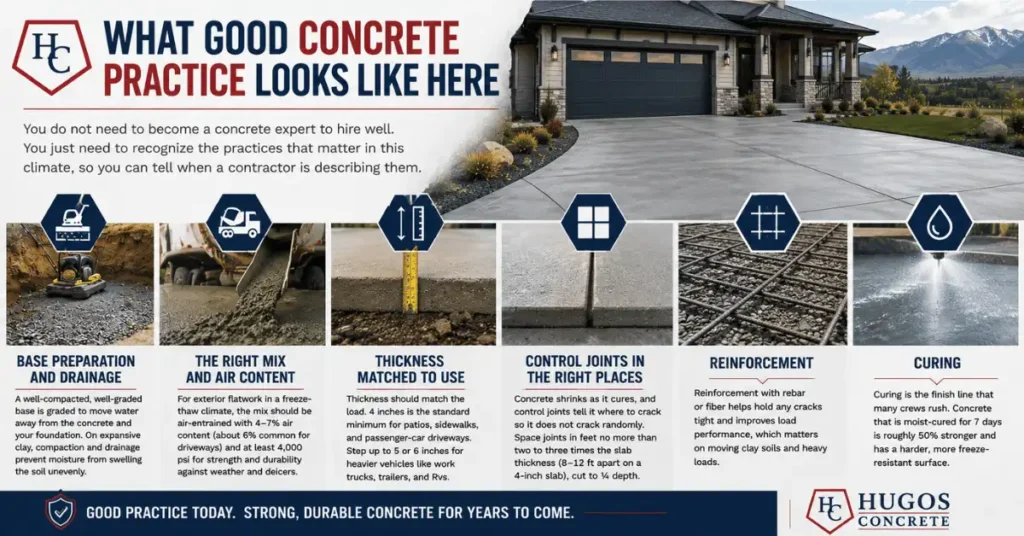
You do not need to become a concrete expert to hire well. You just need to recognize the practices that matter in this climate, so you can tell when a contractor is describing them.
Base preparation and drainage
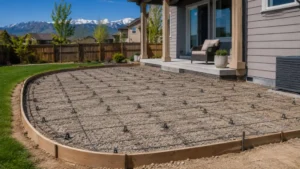
Everything starts under the slab. A crack-resistant pour sits on a well-compacted, well-graded granular base that is graded to move water away from the concrete and your foundation. On our expansive clay, compaction and drainage are not optional extras. They are what keeps moisture from swelling the soil unevenly beneath the slab. If a contractor spends more time talking about the pour than the prep, that is a warning sign.
The right mix and air content
For exterior flatwork in a freeze-thaw climate, the mix should be air-entrained. The Concrete Network notes that exterior concrete typically targets an air content in the range of about 4 to 7 percent, with roughly 6 percent common for driveways. Strength matters too: at least 4,000 psi is recommended for driveway concrete exposed to weather and deicers. Locally sourced ready-mix, batched to a proper local spec, is part of how a good crew controls this.
Thickness matched to use
Thickness should match the load. Industry guidance from the Concrete Network puts 4 inches as the standard minimum for residential patios, sidewalks, and passenger-car driveways, stepping up to 5 or 6 inches for heavier vehicles like work trucks, trailers, and RVs. More thickness is not always the answer, but too little always is a problem.
Control joints in the right places
Concrete shrinks as it cures, and control joints tell it where to crack so it does not crack randomly. The rule of thumb, per the Concrete Network, is to space joints in feet no more than two to three times the slab thickness in inches, which puts joints on a 4-inch slab roughly 8 to 12 feet apart, cut to about a quarter of the slab’s depth. The National Ready Mixed Concrete Association covers the same jointing principles. Well-placed joints are one of the clearest signs of a crew that plans ahead.
Reinforcement and curing
Reinforcement with rebar or fiber helps hold any cracks tight and improves load performance, which matters on moving clay soils. And curing is the finish line that many crews rush. Concrete that is moist-cured for seven days is roughly 50 percent stronger than concrete left to dry out, with a harder, more freeze-resistant surface. A contractor who explains a curing plan is protecting your investment after the pour.
Three Myths About Northern Colorado Concrete
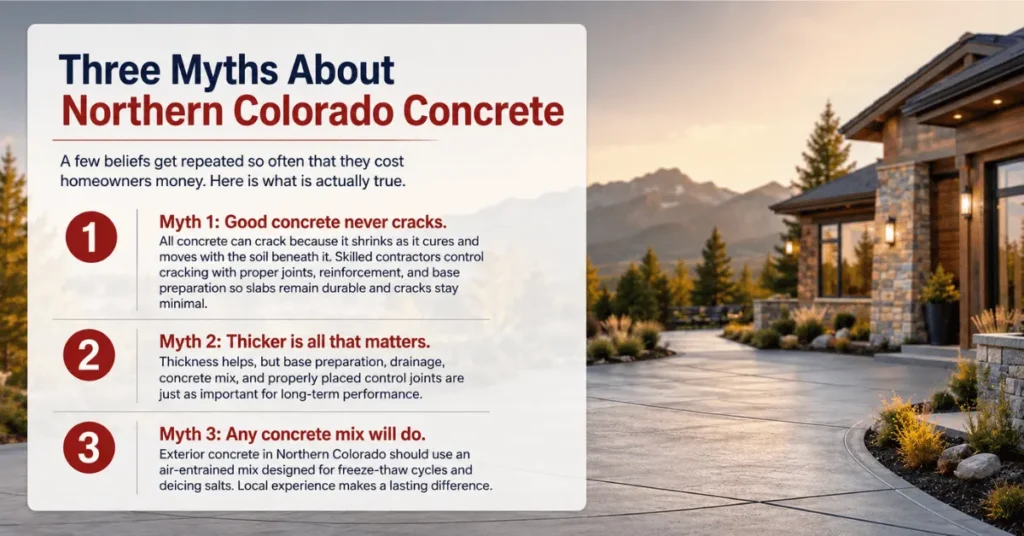
A few beliefs get repeated so often that they cost homeowners money. Here is what is actually true.
Myth 1: Good concrete never cracks. All concrete can crack, because it shrinks as it cures and it moves with the soil beneath it. The goal of a skilled crew is not to promise zero cracks but to control them with proper joints, reinforcement, and base prep so the slab stays sound and the cracks stay hairline and hidden. Anyone guaranteeing a permanently crack-free slab is overselling.
Myth 2: Thicker is all that matters. Thickness helps, but a thick slab poured on a poorly compacted base, with the wrong air content and no joints, will still fail. In this region, base prep, drainage, mix, and jointing carry at least as much weight as raw thickness.
Myth 3: Any concrete mix will do. A generic mix without proper air entrainment scales and spalls under Front Range freeze-thaw and deicing salts. Local conditions call for a mix specified for exterior, freeze-thaw exposure. This is exactly where a contractor’s local experience shows up.
Want a straight assessment of your soil, slope, and project? We evaluate the site before we ever quote a number. Talk to Hugo’s Concrete about your project or call (970) 988-3198.
Hiring Questions by Project Type
The fundamentals above apply everywhere, but each kind of project has a few questions worth asking specifically.
Driveways
A driveway carries the heaviest loads on your property, so ask about thickness and reinforcement for your vehicles, and about how the crew will handle drainage and the transition to the street or garage. Ask what air content and strength they spec for exterior exposure. Our concrete driveway work in Northern Colorado is built around exactly these questions, because a driveway is the project most punished by freeze-thaw and heavy use.
Patios
Patios are about drainage and finish. Ask how the crew will slope the slab away from the house, what finish options fit your use and your slip-resistance needs, and how they will place joints so the surface stays attractive as it ages. A well-built concrete patio should shed water, resist heaving, and still look clean after years of Colorado weather.
Floors
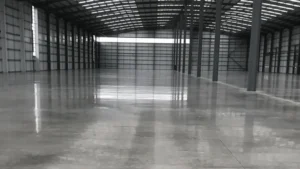
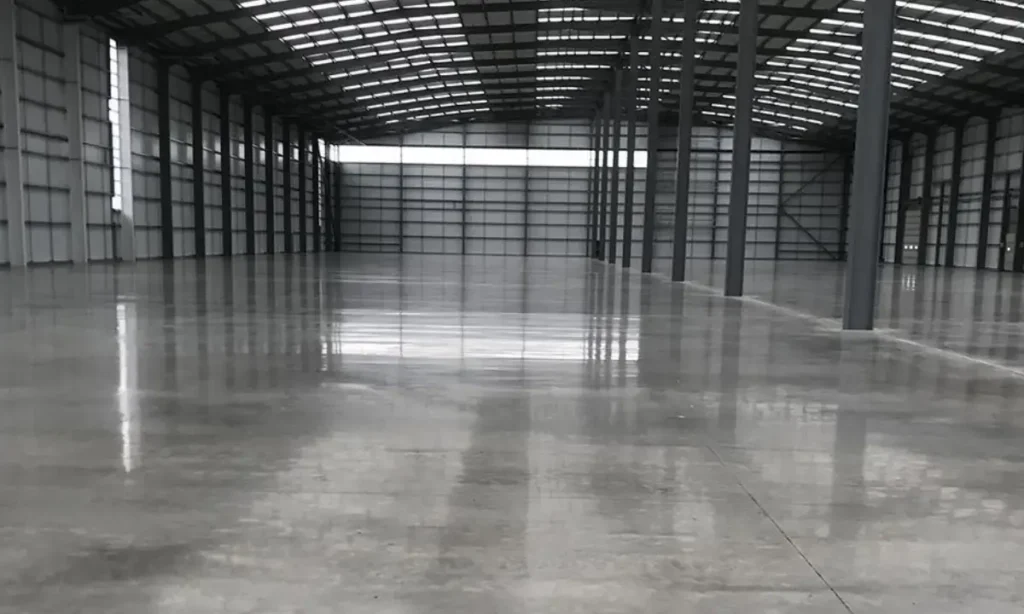
Interior floors, garages, and commercial slabs come down to surface quality and moisture control. Ask how the contractor preps and grinds the existing surface, whether polished, sealed, or coated finishes fit your space, and how they manage moisture. Our concrete flooring and polishing work is where surface prep and finishing skill matter most, because there is no landscaping to hide an uneven floor.
Protecting the Slab After the Pour
Good concrete does not stop needing attention the day the crew leaves. In a freeze-thaw climate, a little maintenance goes a long way toward reaching the decades of life a properly built slab is capable of.
Ask your contractor whether and when they recommend sealing. A quality sealer helps keep water and deicing salts from soaking into the surface, which is exactly what drives scaling and spalling through our winters. Be especially careful with deicers on new concrete: the common guidance is to avoid chemical deicers entirely during the first winter and to use sand for traction instead, while the surface reaches full strength.
The rest is simple. Keep water draining away from the slab and your foundation, clear snow promptly rather than letting meltwater refreeze on the surface, and address any settling or drainage changes early. None of this is complicated, but a contractor who raises it up front is one who expects their work to last, and who wants yours to as well.
Building for the Long Run
Northern Colorado concrete rewards contractors who respect the ground and the climate, and it punishes the ones who cut corners. When you understand freeze-thaw, expansive clay, base prep, mix design, joints, and curing, you can hear the difference between a crew that builds for this region and one that pours a generic slab and hopes.
Hugo’s Concrete was built for exactly this. We are a family-owned, licensed, and insured contractor serving Fort Collins, Loveland, Windsor, Greeley, and communities across Northern Colorado, and owner Hugo personally oversees every project from soil evaluation to the final walkthrough. We use locally sourced ready-mix, reinforce every pour, and stand behind our work, because concrete built for this climate should last decades, not seasons.
When your project deserves concrete built for Northern Colorado, start with a conversation. Request your free estimate from Hugo’s Concrete and we will walk your site, assess the conditions, and give you a straight plan.